Tools for Navigators
If one believes that the greatest shift AI will bring to the world of knowledge work is to transform us from being repositories of expertise toward being navigators of expertise, then it is imperative that we start thinking now about the types of tools that navigators will need
If one believes, as I do, that the greatest shift AI will bring to the world of knowledge work is to transform us from being repositories of expertise toward being navigators of expertise, then it is imperative that we start thinking now about the types of tools that navigators will need. Because navigation requires an inherently different orientation and skillset than being an individual expert - it's less about knowledge, and more about orchestration and how well you can infer patterns and coordinate the necessary connections and logistics. None of this happens in a vacuum - navigators need tools too. To succeed in this world then, we need to ask ourselves: what tools do the navigators need?
The answer is two-part. First we need to understand the nature of these tools and the capabilities they should provide. Second, we need to understand how they will be built. To be a navigator, it is a reasonable presumption that one still needs to determine a direction and bring enough skill and knowledge of self to navigate, even if one doesn't quite know how to get there yet. A map alone is insufficient; sailors must still know how to sail. And while knowledge of the winds helps, a good GPS isn't bad to have along for the ride. This is the foundation that quality tools set.
The Soul of a Tool
In the grand scheme, knowledge work revolves around information, the ability to extract and create meaning from it, and the ends towards which we deploy that meaning - that's to say, the ability to take shared action toward a goal. The modern information corporation is an abstraction built upon this core system, in which labor, capital, and knowledge is turned into ever more capital (and hopefully, some social good). In this world, knowledge isn't just bits and bytes - it's also the accumulated experience of people, their relationships, and the actions they take. AI is redefining how we capture and deploy that information, and allowing us to scale the process of reasoning over vast amounts of information.
There is much talk of human-AI "cyborgs", of how AI use, properly coupled with human direction produces an effect greater than the individual outputs of either party. This requires certain obligations of both parties. Humans must, as Vivienne Ming writes in AI is Cannibalizing Human Intelligence, be comfortable with the discomfort of "not knowing". The tools we create should build this in as a feature. True, some tools just need to provide an answer, and this shouldn't be read as wanting our tax preparation software to make us question the epistemological foundation of taxation. Rather, it applies distinctly to tools on the edge of advanced knowledge work; areas where novelty and best practice become judgement calls. That's to say, those on the jagged technological frontier of AI use.
What are the attributes of tools such as this? Let's assume a baseline set of capabilities, starting with broad access to expertise (which must be easily recallable, and vastly scalable). Beyond this start point, we should consider that:
- First and foremost, they must treat the user as a partner, not just an operator. That is, they don't reduce the experience to one of just following along or providing answers - that would be a disservice to the user. They allow space for exploration and self-service, for challenging embedded opinions, and for creative thought. In fact, the best tools forge new critical thinking skills in their users.
- Second, they are sense-making tools. They help us triage and make sense of vast troves of information, funneling these deluges into a coherent mental model of the world. As complexity grows, these tools must help provide a stabilizing center.
- Third, they are opinionated tools. While generalized, open-ended tools such as ChatGPT are beneficial, they quickly hit a wall. Tools for navigators should be opinionated, even if those opinions are loosely held. All tools have an opinion, the question is simply whose opinion it is. And if you don't think that tools have an opinion, just keep following the money upstream. The mental models we create to interpret our world should feed back into the opinions our tools hold.
- Fourth, they deploy rich proprietary data, primarily that of outcomes experience. While most AI tools train on broad sets of converged data, and many data analysis tools rely on aggregates of micro outcomes, successful tools of the future will rely on the application of macro level outcomes, and then use technology to identify the (potentially nonlinear, non-measurable) signals and drivers that led to that outcome. What's a macro outcome? Delivering a product. Achieving a financial target. Opening a new office. While most data represents micro outcomes, in aggregate, these become more useful signals.
- Five, they can operate semi-autonomously, responding to inputs and suggestions but operating with a degree of independence that frees the user to take on different tasks once the tools have been set in motion. They unshackle the user from place and time.
Put together, these tools allow savvy navigators to move from insights to outcomes quickly.
The Body of a Tool
As the craft of software development evolves, the software itself is no longer the governing artifact. While business rules have previously been either etched in code, written in documents, or stored as tacit knowledge inside the heads of people, LLMs unlock a new paradigm. When the software is not the governing artifact, and when the marginal cost of coding (not development) approaches zero, then software can be torn down and rebuilt. Data and business rules are still required, but they are referenced by the LLMs as they do the coding. Humans guide and navigate in this context then, too.
In our new AI enabled world view, albeit in a slightly reductive manner, that translates to having five things:
- A data foundation
- An extrapolated knowledge layer
- Business rules that define and deploy knowledge meaningfully
- A portfolio of flexible LLMs
- An intelligent interaction layer
How does this manifest?
- Databases
- Knowledge graphs
- Skills & Context
- Unified user interface
- Stitched together by LLMs
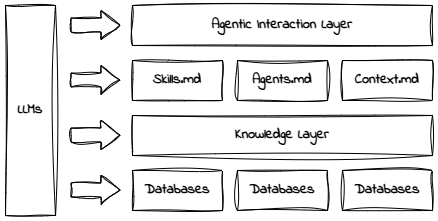
Tool development should focus on knitting pathways that navigate across these dimensions in ways that bring value and expose the "soulful" attributes above. Interestingly, those positioned to best create these pathways aren't necessarily the engineers; they are those with deep subject matter expertise. They will do much of the knitting.
The Personality of a Tool
Once we have these tools, and ready navigators, then what? What does it mean to navigate expertise? How will these tools operate?
- If your expertise cannot be generalized, customized, then refitted to specific new uses, then it is merely a good story. Applied expertise wins the day.
- The default mode will be not just analyzing what happened, but explaining why it happened, and what this pattern means for the future.
- These tools are distribution platforms for knowledge, and must be improved constantly. This means that organizations and individuals need to continually contribute their own knowledge back to the pool. In this way, they lift others up as well. This is a different way of working, and emphasizes the collective over the individual. New incentive models are required to do this well.
Looking Ahead
To navigate expertise is only half the battle; one must be able to transmit it as well. And, as the AI acceleration grows, we will continue to see that the limiting factor in transmitting expertise is no longer the ability to generate and share it, but the ability to receive and act upon it - and action is still squarely a human imperative, no matter how agentic our tools become.
Ultimately, and most importantly, navigators need tools that connect them to other navigators - or at minimum, tools that free up enough time for the navigators to have dinner and tell stories together. To that end, our tools must continue to treat human connectivity as central to the experience.